

PARGamma
Structural Intelligence for Income Investors
12
Canonical, Financial Literacy Intelligence per Preferreds/ Hybrids
™
Insight Beyond Income


January 26, 2026 PARGamma Intelligence Brief Issue-Guided Illustration:


PARGamma analyzes preferred and hybrid income instruments through structural comparison rather than recommendation.
PARGamma briefs are not market commentary. They are structured analytical instruments.
Each section serves a specific function. Below is a short excerpt from each section of the January 26, 2026 brief, followed by a description of what that section is designed to do.
Executive Structural Framing
What this section does
Orients the reader immediately to why the issue matters structurally. It names the regime, removes misleading surface explanations, and establishes the core tension—without examples, forecasts, or conclusions.
Sample excerpt
As of late January 2026, preferred and hybrid income markets are operating within a binding structural regime. This designation reflects not heightened volatility or deteriorating issuer fundamentals, but the resolution of several macro conditions that previously allowed structural fragility to be absorbed without consequence.
Regime Definition & Boundary Conditions
What this section does
Defines the analytical perimeter. It tells the reader what is being analyzed—and just as importantly, what is not—so conclusions are not overgeneralized or misapplied.
Sample excerpt
This regime does not imply systemic instability. Capital markets remain open, payment continuity across preferred and hybrid instruments is broadly intact, and issuer balance sheets have not experienced widespread deterioration.
Structural Context
What this section does
Explains why conditions can feel stable even as tolerance has narrowed.
This section reduces confusion and prevents readers from mistaking the absence of stress for structural safety.
Sample excerpt
Because these resolutions occurred sequentially and without crisis markers, they did not register as destabilizing events. Structures that relied on balance-sheet elasticity, discretionary sponsorship, or steady secondary-market depth continued to function.
Structural Observation — Capital Hierarchy
What this section does
Shows how capital hierarchy reasserts itself once ambiguity is removed.
It explains order of adjustment, not issuer quality or intent.
Sample excerpt
Preferred structures began to differentiate not by issuer reputation or payment history, but by their position within the capital stack and the clarity of their loss-absorption rules.
Structural Observation — Liquidity Behavior
What this section does
Explains non-event-driven repricing. This section shows how liquidity becomes conditional rather than disappearing, and why price moves can occur without volume or catalysts.
Sample excerpt
By late-2025, liquidity became conditional. Access increasingly depended on reversibility, capital treatment, and balance-sheet efficiency rather than on sentiment or yield demand.
Applied Structural Comparisons
What this section does
Destroys false equivalence. Using tables and structure-level comparisons, this section allows practitioners to discuss risk without naming securities or revealing positions.
Sample excerpt
In a binding regime, surface similarity obscures material structural differences. Instruments that appear comparable by issuer quality or coupon continuity diverge meaningfully once hierarchy and liquidity conditionality govern outcomes.
Cross-Structure Synthesis
What this section does
Extracts reusable patterns. This is where individual observations become shared language that can be used in investment committees, family offices, and internal discussions.
Sample excerpt
These patterns recur because the same constraints apply across structures, regardless of issuer quality or payment history.
Structural Resolution
What this section does
Collapses ambiguity without telling the reader what to do.
It narrows decision space through exclusion, not advocacy.
Sample excerpt
Structural resolution means that fewer assumptions remain viable. It does not mean that outcomes are predetermined, nor that action is required.
What This Invalidates
What this section does
Explicitly retires obsolete assumptions.
This prevents legacy frameworks from being misapplied to a new regime.
Sample excerpt
Coupon payments and dividend continuity no longer serve as reliable indicators of structural resilience. Repricing can occur without interruption and without signaling issuer distress.
What to Watch
What this section does
Provides forward awareness without prediction. It identifies signals that confirm whether the regime remains operative—without timing, targets, or triggers.
Sample excerpt
Depth thinning independent of price movement indicates liquidity reversibility stress rather than sentiment shift.
Practice Implications & Closing
What this section does
Translates insight into orientation, not action. It helps practitioners explain outcomes calmly and defensibly to clients and committees..
Sample excerpt
The practical implication is not urgency. It is discipline.
How to Read a PARGamma Brief
A PARGamma brief is not meant to be skimmed for conclusions.
It is meant to be used as a shared interpretive instrument.
Readers typically use it to:
explain divergence without attributing error,
discuss exposure without revealing trades,
and understand why outcomes occur even when fundamentals remain intact.
Final Doctrine
PARGamma documents when structure stops forgiving error.
Decisions may follow.
Predictions do not.
Relationship to Forlytica Research Group™
PARGamma receives input from foundational research conducted within the Forlytica Research Group, including work in:
evidence-weighted inference
environmental signal analysis
drift and stability modeling
high-dimensional system evaluation
Forlytica Applied translates validated research into operational, institutional, and commercial implementations.
Integrity & Use Notice
Public materials on this page are descriptive of applied frameworks and engagement models.
They do not constitute investment, legal, medical, or regulatory advice.
All Forlytica Applied Intelligence frameworks adhere to evidence-weighted reasoning, transparent assumptions, and domain-appropriate validation standards.
Structural intelligence for preferreds and income instruments
Grounded in capital hierarchy, liquidity behavior, and recoverability under stress
Explains why income strategies fail quietly, before price makes it obvious
What PARGamma Does
Practitioners use PARGamma to:
How Income Investors Use our Work
• Evaluate tradeoffs between income
structures
• Identify hidden fragility before it
appears in price
• Distinguish volatility from
permanent repricing
• Avoid instruments with poor
recoverability profiles
• improve decision consistency
across market regimes
PARGamma Access
Subscriber-only structural comparisons, regime analysis, and ongoing refinement of classification logic.
Proprietary Research
Public Research
Framework essays and structural analysis designed to establish orientation and shared language.
About PARGamma
PARGamma exists to address a persistent gap in income investing: the difference between how income instruments are described and how they actually behave when conditions change.
Preferred securities and income instruments are often treated as stable by construction. In practice, their outcomes are governed by capital hierarchy, liquidity behavior, and regime dominance—factors that are poorly captured by yield, narratives, or historical comfort.
PARGamma was built to make those governing structures explicit, and to provide a consistent interpretive layer for practitioners who work with preferreds and income markets.
Structural Intelligence for Income Practice
The work here is designed to support real-world income practice: opportunity identification, yield evaluation, portfolio construction, and risk management. It does so by anchoring analysis in the structural conditions that determine outcomes long before price movement or headlines force recognition.
This is not academic theory.
It is not tactical signal generation.
It is a disciplined way of seeing income risk clearly and consistently across market regimes.

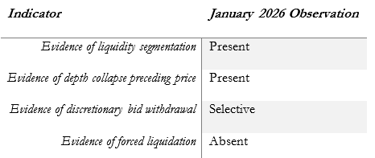
January 2026 Intelligence Brief Table
Structured by the Forlytica Research Group™
For foundational research briefs, scientific insights, and the core architecture behind applied intelligence, visit Forlytica.com.
INSTITIUTIONAL ENGAGEMENTS & PARTNERSHIPS
INQUIRIES
© 2025-26. All rights reserved.
Explore Partnership or Licensing Opportunities
Forlytica Applied provides research-derived frameworks, diagnostics, and applied intelligence services for institutional and organizational use. Materials presented are descriptive of methodology and engagement models and are not intended to constitute investment, legal, medical, or regulatory advice.
Forlytica Applied is a division of the Forlytica Research Group, responsible for translating validated research frameworks into applied, institutional, and commercial implementations.
Forlytica Applied
United States